
Gratitude, Creativity & Play: How EverStar Celebrates the Holiday Season
The holiday season in a preschool classroom is one of those things that can go one of two ways.
It can become a blur of themed crafts, sugar, and overstimulated children counting down the days until winter break. Or it can become something genuinely meaningful: a season where children slow down, notice the people around them, create with intention, and build memories that actually last.
At EverStar Academy of Discovery, we aim for the second one every year.
Here's how we think about the holiday season, and why our approach looks a little different from what you might expect.
It Starts With Slowing Down
December in particular has a way of speeding everything up. Schedules get packed. Routines get disrupted. Children feel the excitement (and the anxiety) radiating off the adults around them, and they absorb all of it.
One of the most important things we do in our classrooms during the holiday season is deliberately slow the pace rather than match the frenzy.
In a Reggio Emilia-inspired environment, this isn't a hard pivot. The same principles that guide our everyday practice (follow the child's curiosity, observe before directing, let meaning emerge) apply to how we approach the holidays too. We don't overschedule the weeks between Thanksgiving and winter break.
We create space. And we let the season be what it actually is: an invitation to notice, reflect, and connect.
Gratitude as a Practice, Not a Poster
Walk into a lot of early childhood classrooms in November and you'll find a construction paper turkey with feathers labeled "I'm thankful for my dog" and "I'm thankful for pizza."
That's not nothing. But it's also not a gratitude practice.
True gratitude in young children develops through repeated, small, authentic experiences. Not through a once-a-year craft. It develops when a child finishes building something difficult and a teacher pauses to notice the effort with them. When a friend shares without being asked and someone names what that felt like. When a child receives something and is helped to feel the fullness of it, not just say thank you on autopilot.
In our classrooms, we weave gratitude into the fabric of the season through conversation, documentation, and intentional small moments rather than large performances of it. Teachers might facilitate a circle time where children share one specific thing they noticed today that made them feel glad. Or help a child write and illustrate a real letter to someone they love. Or document in photographs and words the small daily kindnesses that happen between children, then display that documentation so families can see it.
Gratitude practices that stick are built one small moment at a time. That's what we're doing, even when it doesn't look like a holiday project.
Creative Expression in the Season
The holiday season is one of the richest times of year for creative expression in early childhood, not because of the themed projects, but because the season itself is so full of sensory and emotional material to work with.
The smell of pine. The sound of music everywhere. The feeling of anticipation that's almost physical in a four-year-old's body. The complexity of feelings that come with family gatherings, change in routine, and the particular kind of excitement that can tip into overwhelm without warning.
In our classrooms, we give children materials and space to process all of that creatively, without prescribing what the output should look like.
That might mean a child who is missing a grandparent far away spends time making something for them, with a teacher sitting nearby, listening to what comes out. Or a group of children who are fascinated by wrapping paper and ribbon use those materials for a week of texture exploration, collage, and design. Or a child who feels most settled when they're using their hands works through the seasonal excitement through clay, building something they can return to and reshape as the days go on.
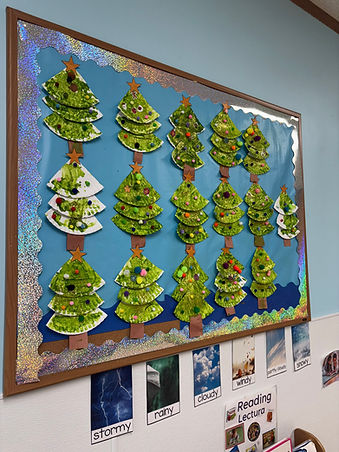
Creative expression during the holidays doesn't mean every child makes the same ornament. It means every child has a way to make the season feel like something they participated in, not just something that happened to them.
Play That Matches the Season
The holiday season is also one of the best times of year for the kind of dramatic play that builds social and cognitive skills in deep and lasting ways.
Children this time of year are already doing it spontaneously: setting up pretend kitchens to make holiday food, recreating gift-giving scenarios, organizing "parties" for their stuffed animals, playing out the family dynamics they've observed at home. Our job isn't to redirect that play toward something more structured. It's to support and enrich it.
We might add loose parts to the dramatic play area that evoke winter and celebration (pine cones, ribbon scraps, small boxes, fabric in seasonal colors) without prescribing what children do with them. We might introduce books and stories that open conversations about different ways families celebrate this time of year, broadening the imaginative territory children draw from when they play.
And we protect play time fiercely during a season when it's most tempting to replace it with performances, parties, and productions. Children don't need a December full of events. They need the same thing they need in September: time, space, rich materials, and adults who trust them to use all of it well.
How We Include Families
The holiday season is also one of the most natural times to deepen the partnership between school and home that sits at the center of everything we do at EverStar.
We share documentation of what children have been exploring and creating during the season, not just finished products, but the thinking and conversation behind them. We give families specific, small ways to extend the season's themes at home: questions to ask at dinner, a simple gratitude practice to try before bed, ideas for slowing down together when the pace picks up.
And we invite families into our classrooms, not to watch a performance, but to participate in the kind of learning community we're building together all year.
That distinction matters. A holiday performance puts children on a stage. An invitation into the classroom puts families inside the life their child is actually living here. We prefer the second one.
What the Season Is Really About
We work with children between the ages of a few months and five years old. For most of them, the holiday season is still relatively new. They don't have the accumulated nostalgia that adults carry into December. They're experiencing it freshly, with the particular intensity that young children bring to everything.
That's a gift, if we pay attention to it.
A two-year-old's delight at a strand of lights is not small. A three-year-old's fierce focus on making something perfect for someone they love is not background noise. A four-year-old's unprompted kindness to a friend on a difficult day in the middle of a busy season is not incidental.
These are the moments the season is made of. Our job, in the classroom and at home together, is to notice them, name them, and help children know that what they felt was real and worth holding onto.
That's what we're doing at EverStar this holiday season. And every season.
EverStar Academy of Discovery is a family-centered, Reggio Emilia-inspired preschool in Waxahachie, TX, serving infants through pre-K. We'd love to welcome your family into our community. Get in touch here.
Comments