
The 7 Principles of Reggio Emilia — And How We Live Them at EverStar

If you've visited EverStar Academy of Discovery's website or stopped by for a tour, you've probably noticed something feels different here.
The classrooms don't look like what most people picture when they think "daycare." The teachers aren't standing at the front of a room running through a lesson. The children aren't sitting in rows filling out worksheets. There's a particular quality to the environment — intentional, warm, alive — that parents notice before they can always put words to it.
That quality has a name: Reggio Emilia.
The Reggio Emilia approach to early childhood education originated in the town of Reggio Emilia in northern Italy after World War II. Parents in that community, determined to rebuild something better for their children, partnered with educator Loris Malaguzzi to create schools built on a radical idea — that children are capable, curious, and competent human beings who deserve environments and teachers that treat them that way.
Those schools became internationally recognized as some of the finest examples of early childhood education in the world. The philosophy they developed is now embraced by educators across the globe, including here in Waxahachie, Texas.
At EverStar, we don't just hang the Reggio Emilia name on our wall. We build our daily practice around its seven core principles. Here's what each one actually means — and what it looks like inside our classrooms every day.
Principle 1: Children Are Active Participants in Their Own Learning
The most fundamental shift Reggio Emilia asks educators to make is also the hardest one for traditional schooling to accept: children are not empty vessels waiting to be filled with knowledge. They arrive already full — full of curiosity, theories, questions, and a drive to make sense of the world that is every bit as serious as an adult scientist's.
In a traditional preschool model, the teacher decides what children will learn, when they will learn it, and how. The child's job is to receive and perform.
In a Reggio-inspired classroom, the child's curiosity drives the direction of learning. A teacher might notice that several children are fascinated by shadows on the playground. That observation becomes a provocation — the teacher sets up a light table, brings in materials for shadow play, asks open questions — and a weeks-long project about light, darkness, and reflection unfolds organically from what the children were already interested in.
At EverStar, our educators are trained to watch for these moments. To see what captures a child's attention and follow it somewhere meaningful rather than redirect them back to a predetermined lesson plan.
Principle 2: Learning Thrives Through Collaboration
Young children are often underestimated as social thinkers. The assumption is that real learning happens alone — one child, one worksheet, one right answer. Reggio Emilia pushes back on that hard.
Children learn by bumping their ideas up against other people's ideas. They learn by negotiating, disagreeing, explaining, and being surprised by a perspective they hadn't considered. Collaborative learning — working through problems together, building something jointly, arguing about how to do it and then figuring out who was right — produces deeper thinking than solitary tasks almost every time.
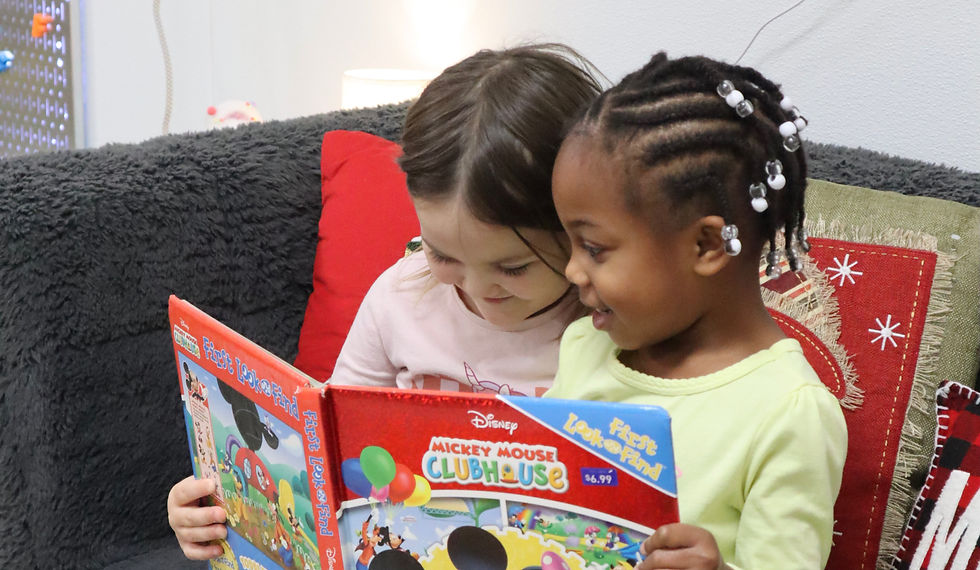
In EverStar's classrooms, you'll rarely see children working in complete isolation. Small groups tackle problems together. Projects are collaborative by design. Teachers facilitate conversations between children rather than always inserting themselves as the answer-giver.
This isn't chaos. It's a carefully structured environment where collaboration is the norm — because we know it's how children learn to think, communicate, and eventually lead.
Principle 3: Children Are Natural Communicators
Communication, in the Reggio philosophy, is far broader than talking. Children communicate through drawing, painting, building, sculpting, dramatic play, movement, music, and storytelling. Loris Malaguzzi called these the "hundred languages of children" — a hundred different ways of thinking and expressing.
A child who can't yet articulate what they're feeling might paint it in furious red strokes. A child working through how a machine operates might build it out of blocks before they can explain it in words. A child processing a difficult social situation might act it out through pretend play over and over until something resolves.
All of these are communication. All of them deserve to be taken seriously.
At EverStar, we make sure children have consistent access to multiple expressive languages throughout their day. Our classrooms are stocked with varied materials precisely because we believe a child shouldn't be limited to the one or two modes of expression that traditional schooling tends to privilege. Every child has a dominant language. Our job is to make sure we're offering the one that lets each child communicate most clearly.
Principle 4: The Classroom Is the Third Teacher
In Reggio Emilia philosophy, three teachers shape a child's experience: the adults, the other children, and the environment itself.
That last one gets overlooked in a lot of early childhood settings. The space is treated as background — functional, clean, adequate. But the environment communicates constantly. A cluttered, chaotic room tells a child their ideas don't have room to breathe. A sterile, institutional space tells them learning is a serious and joyless business. A thoughtfully designed environment — one with natural light, beautiful materials, spaces for both big group energy and quiet individual focus — tells a child that this is a place where interesting things happen and their presence matters.
Every element of an EverStar classroom is intentional. The materials are carefully chosen and beautifully organized. Natural elements are woven in alongside art supplies and loose parts. Display areas showcase documentation of children's work and thinking — not store-bought decorations, but evidence of what these specific children are discovering right now. The room changes as the children's interests and projects evolve.
When parents walk into our classrooms, the environment is already doing its job before a teacher says a word.
Principle 5: Teachers as Partners and Guides
The Reggio Emilia model asks something genuinely difficult of educators: give up being the expert in the room.
Not the knowledge — teachers still bring deep expertise in child development, curriculum design, and learning theory. But the posture. In a Reggio-inspired classroom, the teacher's role is to observe, listen, provoke, and guide — not to stand at the front, deliver information, and assess whether children absorbed it correctly.
This requires a particular kind of professional. Someone who is genuinely curious. Who finds children's thinking interesting rather than something to be corrected. Who can resist the urge to jump in with answers and instead ask questions that send children further into their own inquiry.
Finding and keeping those educators is one of the things we take most seriously at EverStar. Our hiring process, our ongoing professional development, and our culture are all built around this standard. The teachers in our classrooms aren't babysitters with credentials — they are trained, thoughtful educators who approach their work as a genuine intellectual practice.
Principle 6: Documentation as Communication
Walk into an EverStar classroom and you'll notice the walls tell a story.
Not a generic, seasonal story — not turkeys in November and snowflakes in December. A specific story about what these children, in this classroom, have been thinking, building, asking, and discovering over the past weeks.
Documentation in the Reggio Emilia approach means capturing children's learning as it happens — through photographs, transcribed conversations, sketches, and work samples — and making that learning visible to the children themselves, their families, and the broader school community.
This serves several purposes at once. For children, seeing their thinking documented communicates that their ideas are worth preserving and revisiting. For teachers, the documentation process deepens their understanding of where each child is and what they're ready to explore next. For families, it opens a window into a part of their child's life they don't otherwise get to see.
At EverStar, documentation isn't a compliance task or a wall decoration. It's how we communicate. It's how we know what's working. And it's how children learn that the process of thinking — not just the finished product — is something worth paying attention to.
Principle 7: Parents as Partners in Learning
The Reggio Emilia approach was built on a partnership between educators and families — and that partnership has never been treated as a formality.
Parents in Reggio-inspired schools aren't just informed about what their child did today. They're genuine collaborators in the learning community. Their knowledge of their child — what excites them at home, what they're afraid of, what they've been talking about at dinner — is considered essential information for teachers. Their involvement in the school community is welcomed, not just tolerated.
At EverStar, we take this seriously. We communicate regularly and substantively with families about what their children are exploring and how they're growing. We make documentation visible so families can see the depth of their child's thinking, not just receive a report card. And we treat the relationship between home and school as a continuous conversation — because the children we work with don't exist only between drop-off and pick-up.
You know your child better than anyone. We want to learn from that.
Why These Principles Matter — Together
Read any one of these seven principles in isolation and it sounds like a reasonable philosophy. But the real power of Reggio Emilia is what happens when all seven are operating at the same time.
When children are active participants in learning, collaborating with peers, communicating across multiple languages, supported by an environment designed to teach, guided by educators who follow rather than lead, with their learning made visible through documentation, and their families treated as genuine partners — something different happens.
Children become confident. Not just socially, but intellectually. They develop the belief that their ideas are worth pursuing, that confusion is the beginning of understanding rather than evidence of failure, and that learning is something that happens to them and through them — not something done to them by an authority at the front of a room.
That's what we're building at EverStar Academy of Discovery. Not a curriculum. A culture.
EverStar Academy of Discovery offers Reggio Emilia-inspired early childhood education for infants through pre-K in Waxahachie, TX — serving families across the Dallas suburbs including Midlothian, Red Oak, and Ennis. If you'd like to experience these principles firsthand, we'd love to welcome your family for a tour. Schedule your visit here.

Comments